Updated October 2026
Learn what causes electrical surges, how transient voltage can damage sensitive equipment, and how surge protection devices help protect critical power, data, and RF systems.
Surge protection is essential to any application involving sensitive electronics and mission-critical communications.
According to ITIC's 2025 Hourly Cost of Downtime Survey, 93% of mid-sized and large enterprises reported that a single hour of downtime costs $301,000 or more, while 46% reported costs of $1 million to more than $5 million.
This is up sharply from the $5,600 figure widely cited a decade ago. For network operators, downed service isn’t just an inconvenience; it means equipment damage, emergency repairs, and lost revenue, all compounding fast.
Surges Explained
A surge is a spike or other transient disturbance. A brief, high-energy wave of current, voltage, or power that can disrupt, damage, or degrade electronic equipment and interrupt, delay, or corrupt signal transmissions.
Transient disturbances on a power waveform can reach amplitudes of tens of thousands of volts. Network operators are especially vulnerable to equipment damage during lightning strikes, utility switching events, and other transient-inducing conditions.
Equipment Standards
Electrical equipment typically functions at a specific nominal voltage (e.g., 120 Vac, 240 Vac) and can tolerate minor variation in standard operating voltage. Surges, however, carry enough energy to damage virtually any equipment in their path, putting an entire site’s network operability at risk.
Surge Protection
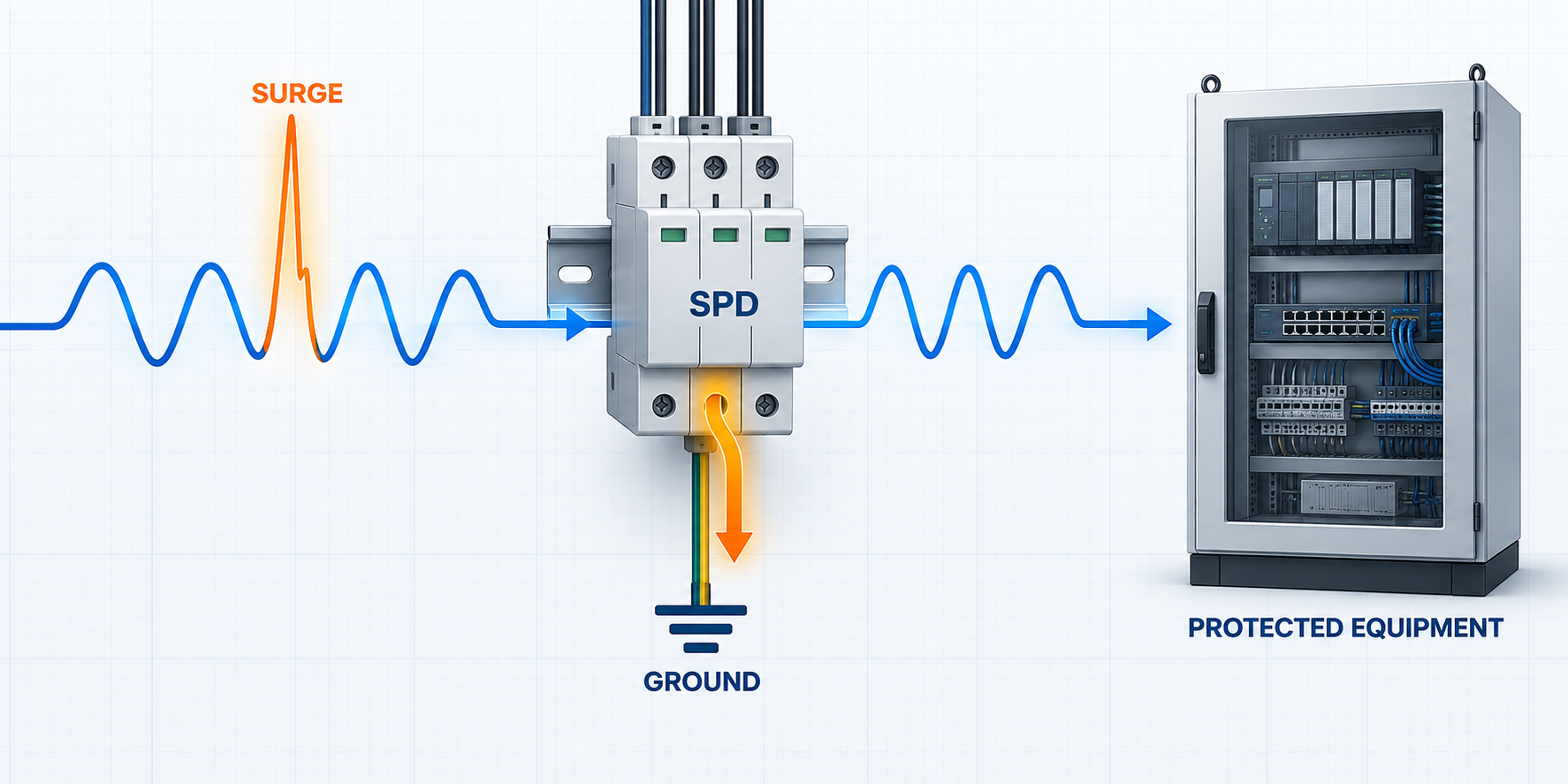
Surge protection devices (SPDs) clamp or divert energy outside nominal levels, reacting in nanoseconds to protect connected equipment.
An SPD diverts excess transient energy to ground before it reaches connected equipment.
By comparison, circuit breakers and fuses typically react in milliseconds to seconds, far too slow to stop a transient. The speed and reliability of a well-specified SPD can be the difference between maintaining network uptime and losing revenue to an outage.
Transtector and PolyPhaser: Complementary Surge Protection
Infinite Electronics companies, Transtector and PolyPhaser, both provide complementary surge protection for mission-critical communications worldwide:
-
Transtector specializes in AC power, DC power, and data-line surge protection, safeguarding power feeds, Ethernet, and other baseband signal paths at cell sites, roadside cabinets, and other critical infrastructure.
-
PolyPhaser specializes in RF and coaxial surge protection, protecting antenna lines, RF equipment, and coaxial signal paths from lightning-induced transients.
Together, the two companies provide complementary protection across RF, power, and data paths, from the antenna and coaxial infrastructure to the equipment rack. Backed by decades of combined experience, patented technology, and quick-turn shipping.
Explore our Surge Protection Solutions:
Frequently Asked Questions (FAQs)
What is an electrical surge?
An electrical surge is a sudden, short duration increase or transient disturbance in voltage or current that can disrupt, degrade, or damage electronic equipment.
What causes electrical surges?
Electrical surges can be caused by lightning, utility switching events, power-system disturbances, and other transient-inducing conditions. Lightning can produce particularly high-energy transients that threaten connected equipment and communications systems.
What does a surge protection device (SPD) do?
A surge protection device (SPD) limits or diverts excess transient energy away from connected equipment. SPDs respond in nanoseconds to help prevent damaging transient energy from reaching sensitive electronics.
Are circuit breakers and fuses surge protectors?
No. Circuit breakers and fuses protect against sustained overcurrent conditions and are not designed to respond to the fast transient events that surge protection devices are designed to address. SPDs and overcurrent protection serve different purposes and can be used together.
What is the difference between power and RF surge protection?
Power surge protection protects AC or DC power circuits from transient energy, while RF surge protection protects coaxial and antenna signal paths from lightning-induced and other RF transients. Data-line surge protection protects Ethernet and other baseband signal paths.