By Dan Rebeck
A traffic camera suddenly goes offline after a thunderstorm. There was no direct lightning strike to the camera or its mounting pole, yet maintenance crews are dispatched, communications are interrupted and equipment inside the roadside cabinet must be inspected.
This scenario is more common than many realize. A nearby lightning strike can induce a powerful electrical surge onto connected cabling, allowing damaging energy to travel well beyond the original event. Ethernet and Power over Ethernet (PoE) cables can become pathways that carry surge energy directly into cameras, network switches and traffic control equipment.
For transportation agencies, a single surge event can affect much more than one field device. Understanding how surge energy travels through an Intelligent Transportation System (ITS) network is the first step toward improving system reliability, reducing downtime and protecting critical infrastructure.
Key Takeaways
- Nearby lightning strikes can damage ITS equipment without making a direct hit.
- Surge energy can travel through Ethernet and PoE cabling into roadside cabinets.
- A single surge event can impact cameras, switches, controllers and other connected equipment.
- Layered surge protection helps stop surge energy before it spreads through the network.
- Understanding the surge path helps agencies design more resilient ITS infrastructure.
Why ITS Cameras Are at Risk
Intelligent Transportation System (ITS) cameras operate in some of the most electrically exposed environments in transportation infrastructure. Mounted on poles, mast arms and overhead structures, they are routinely subjected to severe weather and nearby lightning activity.
Unlike equipment installed inside controlled facilities, ITS cameras are connected by long Ethernet or PoE cable runs that extend from the field device to roadside cabinets. These lengthy cable runs can act as pathways for induced surge energy.
Once surge energy enters the network, it doesn't necessarily stop at the camera. It can continue through the cabling into switches, media converters, traffic controllers and other critical communications equipment inside the cabinet.
The result is that a single lightning event can affect multiple components throughout the system, increasing maintenance costs, extending recovery times and reducing traffic system availability.
Why a Nearby Lightning Strike Can Be Just as Dangerous
Many people assume equipment is only damaged when lightning strikes it directly. In reality, nearby strikes are often responsible for damaging sensitive electronics.
When lightning discharges, it creates an intense electromagnetic field. That rapidly changing field can induce high voltages onto nearby conductors, including Ethernet cables, power lines and communication cables. Even when the strike occurs hundreds of feet away, the induced surge can contain enough energy to damage connected equipment.
Because ITS camera networks often rely on long cable runs spanning intersections and roadside infrastructure, they provide an efficient path for surge energy to travel through the system.
Rather than dissipating harmlessly, that energy follows the connected cabling toward network equipment inside roadside cabinets, where it can affect multiple devices before coming to rest. This is why surge protection strategies should consider the entire network path—not just the camera.
Following the Path of a Lightning Surge
Once surge energy is induced onto the network, it typically follows a predictable sequence.
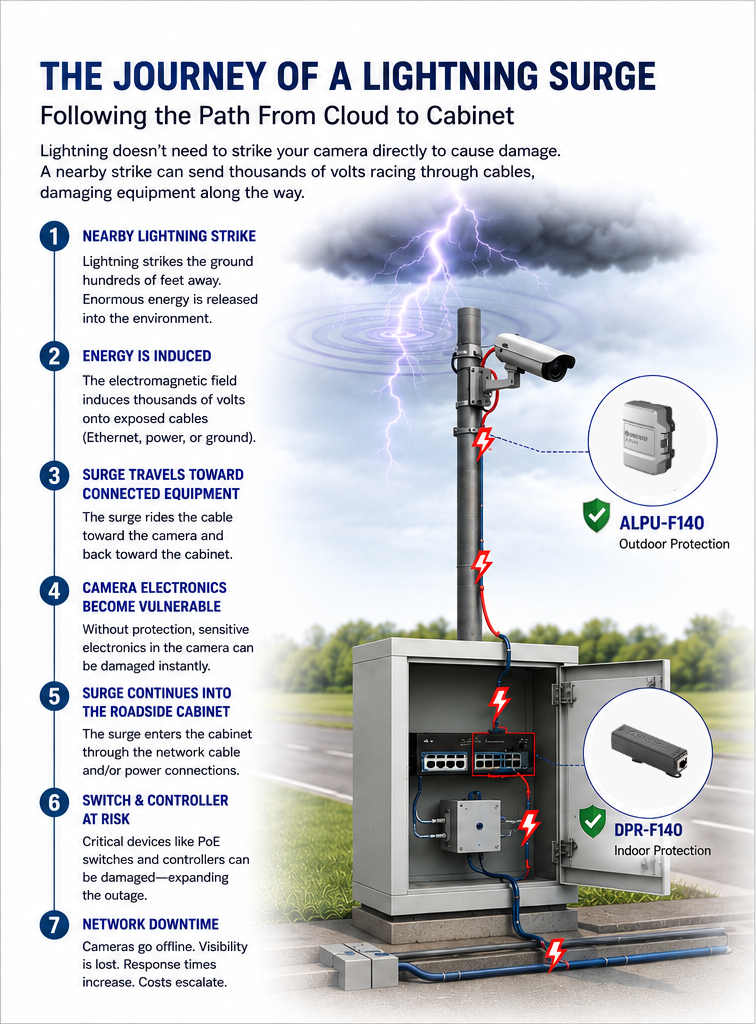
A nearby lightning strike generates a high-energy electromagnetic field. That energy is induced onto Ethernet or PoE cabling connected to the ITS camera. The surge reaches the camera first, then continues through the network cable toward the roadside cabinet.
Inside the cabinet, surge energy can reach switches, traffic controllers and other connected electronics. If left unprotected, the result may be damaged equipment, interrupted communications and costly maintenance.
The typical surge path looks like this:
- Nearby lightning strike
- Surge energy is induced onto connected Ethernet or PoE cabling
- Energy reaches the ITS camera
- Remaining surge continues into the roadside cabinet
- Switches, controllers and connected electronics are exposed
- Equipment damage and network downtime occur
Understanding each step makes it easier to identify where surge protection can intercept the energy before it spreads through the network.
One Surge Can Impact More Than the Camera
When an ITS camera experiences a lightning-induced surge, the consequences often extend well beyond the field device.
Network switches, communications equipment and traffic controllers connected to the same Ethernet infrastructure may also be exposed. In many cases, replacing a damaged camera represents only a small portion of the total recovery effort.
The broader operational impacts can include:
- Damaged cameras and network electronics
- Emergency maintenance dispatches
- Traffic monitoring interruptions
- Reduced situational awareness for traffic management centers
- Unexpected repair and replacement costs
- Increased system downtime
For agencies responsible for maintaining reliable transportation infrastructure, preventing these downstream effects is just as important as protecting the camera itself.
Stopping the Surge Before It Spreads
Because surge energy travels along the entire network connection, protecting only one end of the cable leaves the rest of the system vulnerable.
A layered surge protection strategy helps intercept surge energy before it reaches sensitive electronics.
Indoor & Outdoor Protection
The ALPU-F140 and DPR-F140 work together to protect both ends of an ITS Ethernet connection. Installed near the field device, the outdoor-rated ALPU-F140 diverts surge energy before it reaches the camera or other roadside equipment. Inside the cabinet, the DIN-rail-mounted DPR-F140 helps protect switches, controllers and connected electronics from residual surge energy.
Both support Gigabit Ethernet and PoE++ up to 100 W, feature dedicated shield-to-ground protection, and are UL 497B listed, NEMA TS2 compliant and FDOT APL approved.
Together, outdoor and indoor surge protection create multiple points of defense across the network. Rather than relying on a single protective device, agencies can reduce equipment failures, minimize maintenance visits and improve overall network resilience.
This layered approach aligns with widely accepted surge protection practices for outdoor networking and critical infrastructure applications.
Protecting ITS Networks from Lightning Surges
A nearby lightning strike can affect far more than a single traffic camera. Once surge energy is induced onto connected cabling, it can travel through the network, exposing switches, controllers and other critical roadside equipment to damage.
By understanding how surge energy moves through an ITS network and implementing layered protection at both the field device and the roadside cabinet, transportation agencies can reduce equipment failures, minimize unplanned maintenance and improve system uptime during severe weather.
Want to see the difference layered surge protection can make?
See how layered surge protection helps defend critical ITS infrastructure. Watch Transtector's Lightning Lab demonstration to observe the complete surge path from the field device to the roadside cabinet.
CTA Button: Watch the Lightning Lab Demo
Frequently Asked Questions (FAQs)
Can a nearby lightning strike damage an ITS camera without a direct hit?
Yes. Nearby lightning strikes generate electromagnetic energy that can induce damaging surges onto Ethernet and PoE cabling. That surge energy can travel into connected cameras and network equipment even when the camera itself is not struck directly.
Why are PoE cameras vulnerable to lightning surges?
PoE cameras rely on long Ethernet cable runs that carry both power and data. These cables can act as conductors for lightning-induced surge energy, allowing transient voltages to reach connected equipment.
How does surge energy travel through an ITS network?
After being induced onto connected cabling, surge energy travels through Ethernet or PoE cables from the field device toward roadside cabinets, where it can reach switches, controllers and other network electronics.
Can one lightning surge damage more than one device?
Yes. A single surge event can affect multiple connected devices throughout the network, including cameras, Ethernet switches, communications equipment and traffic controllers.
Where should Ethernet surge protectors be installed?
For the most effective protection, surge protectors are typically installed near the outdoor field device and again inside the roadside cabinet to help protect downstream network equipment.
Does surge protection affect PoE performance?
Properly designed Ethernet surge protectors are engineered to support PoE data and power transmission while providing a safe path for transient surge energy during lightning events.
Why is layered surge protection recommended for ITS networks?
Layered surge protection helps stop surge energy at multiple points before it reaches sensitive electronics. This approach can reduce equipment damage, minimize maintenance costs and improve the long-term reliability of ITS infrastructure.