The popularity of solar power is on the rise in the U.S. and worldwide. With it is a growing need to protect photovoltaic (PV) power systems from transient voltage caused by lightning strikes and other factors. This blog post touches on growing solar use projections before discussing the special surge protection needs of PV systems. It concludes with information about a new line of Transtector DC surge protectors designed for PV systems and several other applications.
Key Takeaways
- DC surge protection is essential for reliable solar performance and safety.
- Choose SPDs rated for your PV voltage, current, and environment.
- Install at key connection points: panel-to-combiner and combiner-to-inverter.
- Use certified, low-response-time SPDs for compliance and durability.
- Proper grounding and maintenance ensure maximum surge mitigation.
Solar Power on the Rise
Over the past decade, there has been a big increase in the adoption of solar power, both in the U.S. and worldwide. It is being driven by falling costs, favorable policies, and increasing public awareness of the benefits of renewable energy.
In 2020, solar power accounted for 43% of all new electricity-generating capacity added to the U.S. grid, making it the largest source of new power capacity for the second year in a row. Additionally, the number of homes and businesses with solar panels installed has been steadily increasing, with over 2 million solar installations across the country as of 2021.
How a Photovoltaic Power System Works
A photovoltaic power system, aka solar power system, works by converting sunlight into electricity through the use of photovoltaic (PV) cells. These cells are made up of semiconductor materials such as silicon and are designed to generate a flow of electrons when exposed to sunlight.
Here's a basic explanation of how a photovoltaic power system works:
- Solar panels: Solar panels are made up of multiple photovoltaic cells that are wired together to produce a specific voltage and current. When sunlight strikes the solar panel, the electrons in the photovoltaic cells generate an electrical current.
- Inverter: Solar panels generate direct current (DC) electricity, which is not suitable for use in most homes and businesses. An inverter converts it to alternating current (AC) electricity.
- Meter: The AC electricity produced by the inverter is sent to an electricity meter, which measures how much electricity your system produces and sends back to the grid.
- Battery: In some cases, a battery is included in the photovoltaic power system to store excess electricity generated by the solar panels for use when there is little or no sunlight.
- Grid connection: If the photovoltaic power system is connected to the electricity grid, any excess electricity generated by the system can be fed back into the grid.
Surge Protection Needs of Photovoltaic Power Systems
PV power systems require surge protection to safeguard the equipment from transient voltage events that could damage or even destroy the system components. Surge protection is necessary because PV systems are often exposed to external factors that can cause electrical surges or spikes, such as lightning strikes, power grid fluctuations, and switching operations. These surges can cause irreparable damage to sensitive electronic components.
Surge protection is the most important for the solar panels. They are not only the most expensive component of a PV power system but are typically located outdoors and exposed to the elements.
Surge protection devices (SPDs) are used to protect the photovoltaic power system by absorbing or diverting transient voltage surges before they can reach and damage the electronic components. SPDs are designed to limit the voltage that reaches the equipment and provide a safe path for excess current to flow to the ground.
Here are some unique needs for surge protection in photovoltaic power systems:
- Direct current (DC) voltage: PV systems generate high DC voltage, which is not common in most electrical systems. This requires SPDs that are designed for DC voltage levels.
- Lightning protection: PV systems are often installed on rooftops or other exposed locations, which makes them vulnerable to lightning strikes. SPDs must be able to handle the high voltage and current levels generated by lightning strikes.
- Grounding: Proper grounding is essential for effective surge protection in PV systems.
- System size: The size of a PV system can affect the surge protection requirements. Larger systems require suitable surge protection devices to handle the higher current and voltage.
- Inverter protection: SPDs must be installed on both the DC and AC sides of the inverter to provide comprehensive protection.
 A Surge Protection Solution for DC PV Power Systems
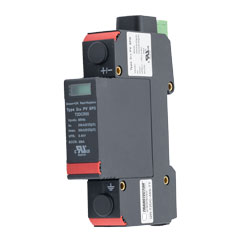
Transtector recently released a line of indoor DC surge protectors that handle the needs of photovoltaic power systems. Our I2R-T2DC line comprises DIN-rail-mount SPDs that use MOV technology (see below) to protect critical equipment that operates on electrical services ranging from 48 Vdc to 1500 Vdc. These SPDs support long-term reliability by safely shunting high amounts of transient energy while maintaining a low clamping voltage.
Applications:
- Photovoltaic power systems
- Communications base stations
- Industrial automation
- IT and data centers
- Utilities
Key Features:
- High-capacity, 50 kA MOV protection
- UL 1449 4th Edition Listed, Type 2 SPDs
- Local and remote visual status indicators
- DIN-rail mount
Benefits of MOV Protection
Metal oxide varistor (MOV) is a type of semiconductor device made up of a metal oxide material with a high resistance that decreases as the voltage across it increases. When a voltage spike or surge occurs, the MOV conducts current and shunts the excess voltage to the ground, thus protecting the electrical equipment and systems connected to it.
MOV surge protection has distinct benefits. It can be used in a wide range of applications, it has a fast response time, and it offers a long service life.
Our I2R-T2DC DC surge protectors, and our entire line of DC SPDs, is in stock and available for same-day shipping. For more info, visit Transtector.com or contact us at +1 (208) 635-6400.
FAQs (Frequently Asked Questions)
Q1: Why do solar power systems need DC surge protection?
A: Because solar arrays are exposed outdoors, they are highly susceptible to lightning and switching surges. DC SPDs prevent damage to expensive components like inverters and charge controllers.
Q2: What’s the difference between AC and DC surge protectors?
A: AC SPDs are designed for alternating current circuits, while DC SPDs handle continuous voltage without polarity reversal critical for PV systems.
Q3: Where should DC surge protectors be installed?
A: At combiner boxes, inverters, and charge controllers, ideally close to where cables enter or leave an enclosure.
Q4: How often should SPDs be replaced?
A: After major surge events or based on manufacturer-recommended inspection intervals (typically every 5–10 years).
Q5: What certifications should I look for?
A: Look for UL 1449 4th Edition, IEC 61643-31, or EN 50539-11 certification for photovoltaic DC systems.